
Why Avocado Oil? The Nutrition Behind the Green
Understanding what makes virgin avocado oil different
Avocados have a well-established reputation as a nutritious food. They're rich in unsaturated fats and contain fibre, vitamins, minerals and naturally occurring plant compounds.
But avocado oil is not simply a concentrated version of the whole fruit.
When avocados are cold-pressed, their oil-soluble components are extracted, including fatty acids, vitamin E, plant sterols and some natural pigments. Fibre, most minerals and water-soluble vitamins largely remain behind.
Understanding this distinction helps explain what makes virgin avocado oil nutritionally valuable, and where the science is still developing.
1. The fatty acid profile: why the type of fat matters
The most important nutritional characteristic of avocado oil is its fatty acid composition.
Like extra virgin olive oil, avocado oil is predominantly monounsaturated, with oleic acid (omega-9) its principal fatty acid.
Research consistently demonstrates that replacing saturated fats with unsaturated fats can improve blood cholesterol profiles, particularly by reducing LDL cholesterol.
This is one of the strongest evidence-based reasons for choosing avocado oil over fats high in saturated fatty acids.
Avocado oil also contains palmitoleic acid (omega-7), linoleic acid (omega-6) and smaller amounts of other fatty acids.
Omega-6 linoleic acid is an essential fatty acid, meaning our bodies cannot manufacture it and must obtain it through food.
Omega-7 palmitoleic acid is being investigated for possible metabolic effects, but clinical evidence is not yet sufficient to support specific health claims from consuming avocado oil.
2. Nutritional composition: avocado oil versus olive oil
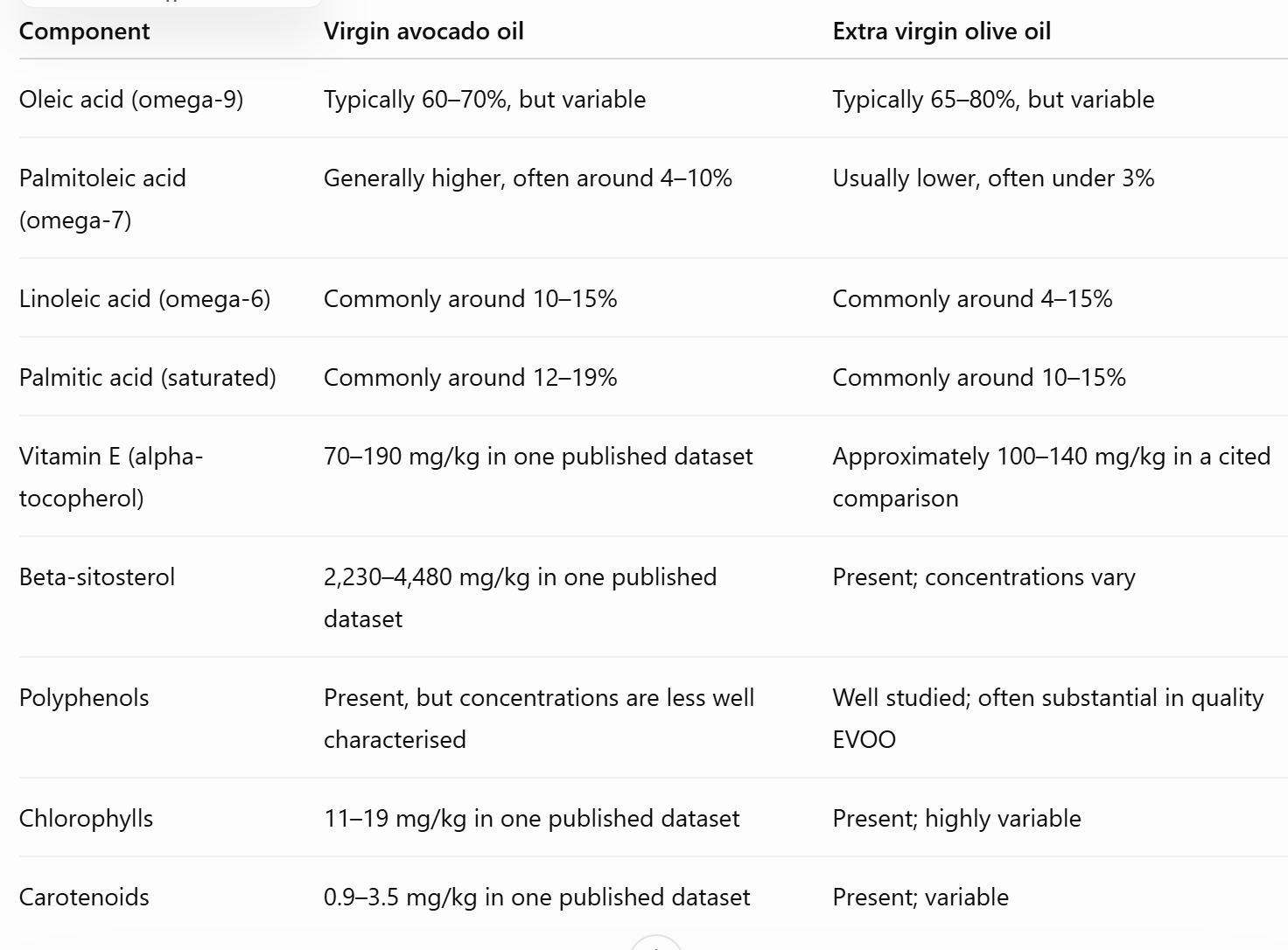
Both oils have similar foundations but differ in the proportions of fatty acids and minor plant compounds.
The following table provides representative values from published research. Actual composition varies with cultivar, fruit maturity, processing and storage.
ComponentVirgin avocado oilExtra virgin olive oilOleic acid (omega-9)Typically 60–70%, but variableTypically 65–80%, but variablePalmitoleic acid (omega-7)Generally higher, often around 4–10%Usually lower, often under 3%Linoleic acid (omega-6)Commonly around 10–15%Commonly around 4–15%Palmitic acid (saturated)Commonly around 12–19%Commonly around 10–15%Vitamin E (alpha-tocopherol)70–190 mg/kg in one published datasetApproximately 100–140 mg/kg in a cited comparisonBeta-sitosterol2,230–4,480 mg/kg in one published datasetPresent; concentrations varyPolyphenolsPresent, but concentrations are less well characterisedWell studied; often substantial in quality EVOOChlorophylls11–19 mg/kg in one published datasetPresent; highly variableCarotenoids0.9–3.5 mg/kg in one published datasetPresent; variable
These are representative research values, not analytical results for The Avo Keeper. Values from different studies should not be interpreted as direct matched comparisons.
3. Vitamin E: protection against oxidative damage
Vitamin E is an essential fat-soluble vitamin with an established role in protecting cells from oxidative damage.
Virgin avocado oil contains alpha-tocopherol, the form of vitamin E recognised for its nutritional activity in humans.
The concentration depends on the avocado variety, growing conditions and extraction method.
Cold pressing is valuable because it avoids some of the intensive processing steps used in refined oil production, helping retain naturally occurring minor compounds.
However, vitamin E concentrations vary considerably across both avocado and olive oils. Neither should automatically be considered superior without laboratory testing.
4. Phytosterols: the plant compounds worth understanding
Phytosterols are naturally occurring compounds found in plant foods.
They have a chemical structure similar to cholesterol and can compete with cholesterol for absorption in the intestine.
Beta-sitosterol is the predominant phytosterol found in avocado oil.
Research has reported substantial concentrations of beta-sitosterol in virgin avocado oil, and some direct comparative studies have found higher total phytosterol concentrations in avocado oil than in olive oil.
However, the distinction between a compound's biological activity and the effect of eating a normal serving is important.
Clinical studies demonstrating cholesterol reduction typically use approximately 1.5–3 grams of plant sterols per day.
A tablespoon of avocado oil containing approximately 3,000 mg/kg of phytosterols would provide only around 40 mg.
So while phytosterols are an interesting nutritional characteristic of avocado oil, a normal serving should not be expected to produce the cholesterol-lowering effects demonstrated with concentrated plant sterol products.
5. Polyphenols: where olive oil has the stronger evidence
Polyphenols are plant compounds with antioxidant properties.
Extra virgin olive oil contains a particularly well-studied group of phenolic compounds, including hydroxytyrosol derivatives and oleocanthal.
Their concentrations vary significantly, influenced by olive variety, harvest timing and processing.
These compounds contribute to olive oil's characteristic bitterness and pepperiness, as well as its oxidative stability.
Avocado oil also contains phenolic compounds, but their identities, concentrations and potential human health effects are less comprehensively researched.
The avocado oil research published by Woolf and colleagues in 2009 concluded that phenolics had not been found in high concentrations in the avocado oils studied.
This does not mean virgin avocado oil is without antioxidants. It means polyphenols are not currently its strongest evidence-based nutritional distinction.
For avocado oil, the more defensible emphasis remains its unsaturated fatty acids, vitamin E and phytosterols.
6. Carotenoids, lutein and chlorophylls
Virgin avocado oil retains some of the natural pigments found in avocados.
These include carotenoids, such as lutein, and chlorophylls.
Lutein is a component of the macular pigment in the human retina. Dietary lutein has been investigated for its relationship with eye health, although the small quantities found in avocado oil do not establish a direct eye-health benefit.
Chlorophylls contribute to the oil's distinctive green appearance.
While chlorophyll-related compounds have been studied for antioxidant activity, evidence of meaningful health benefits from consuming the concentrations present in avocado oil remains limited.
Chlorophylls also have an important relationship with oil quality.
When exposed to light, chlorophyll pigments can act as photosensitisers, encouraging oxidation. This can contribute to changes in flavour, colour and freshness.
For this reason, packaging matters.
Amber glass reduces light exposure, helping protect the natural compounds and sensory qualities of virgin avocado oil.
Colour is one indication of an oil's natural composition, but it is not a reliable freshness test on its own. A greener oil is not necessarily fresher or more nutritious, and colour can change for reasons unrelated to spoilage.
7. Why cold pressing matters
Virgin avocado oil is mechanically extracted without the intensive refining processes used to manufacture many conventional cooking oils.
This approach helps retain naturally occurring components, including tocopherols, phytosterols and pigments.
However, the nutritional composition of a cold-pressed oil still depends on the quality of the fruit, processing conditions and how the finished oil is stored.
Cold pressing is therefore an important part of the quality story, rather than a guarantee that every nutrient will be present at a particular level.
8. What does the research on whole avocados tell us?
Research into whole-avocado consumption has explored cardiovascular health, blood cholesterol, weight management, gut health, cognition and other areas.
This includes the work summarised by Dr Nikki Ford through the Avocado Nutrition Center.
These studies contribute to our understanding of avocados as a food, but their findings cannot automatically be applied to avocado oil.
Whole avocados contain dietary fibre and many other nutrients that are not present in significant quantities in the extracted oil.
Avocado oil's nutritional value must therefore be assessed primarily through its own composition and relevant research on dietary fats.
So, why choose virgin avocado oil?
The nutritional argument is straightforward.
Virgin avocado oil is rich in monounsaturated fats, particularly oleic acid, which can support healthier cholesterol levels when used in place of saturated fats.
It also contains vitamin E, plant sterols and small amounts of naturally occurring carotenoids and pigments.
Extra virgin olive oil has a more extensively researched polyphenol profile. Virgin avocado oil offers a different composition, with its own nutritional characteristics.
Neither oil needs to be declared the winner.
At The Avo Keeper, we believe good food starts with good ingredients. Our virgin avocado oil is cold-pressed from New Zealand avocados, with care taken to protect its natural qualities from production through to your kitchen.
Good fats, naturally occurring nutrients and an oil made to be enjoyed every day.